(An essay by Paradox Pollack posted to Medium.org on Oct 2, 2026)
Pandora’s Paradox and the Eleventh Principle – A direct response letter to John Law
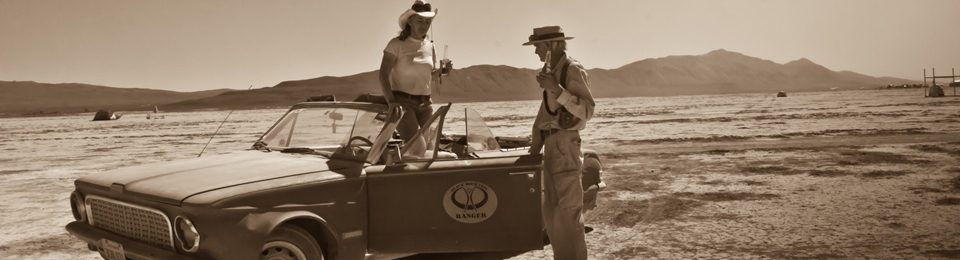
John— In 1993 you drove me out toward the desert and left me at Trego Hot Springs with a gallon of water, the shade of one shitty tree, and the reassuring information that my circus crew would probably materialize eventually.
That was Burning Man.
Not because abandonment was one of the Ten Principles. There were no Ten Principles. There was heat, uncertainty, insufficient infrastructure and one remarkably efficient spiritual teaching:
Now what are you going to do?
I keep returning to that question whenever somebody says Burning Man lost its soul. Because I don’t think it did. I think something more interesting happened, and therefore something harder to dismiss: Burning Man succeeded. And like most successful human inventions, it immediately began producing both the thing it had hoped for and an exquisitely engineered method of avoiding it.
Call this Pandora’s Paradox: every developmental invention seems to release its gift and its shadow at the same time. The beautiful and the destructive do not arrive in separate shipments. They come through the door holding hands.
The original Burning Man culture was not built from principles. The principles were built from the culture. The desert demanded self-reliance, rewarded participation, inspired gifting, made cooperation insanely useful, and made almost everything except immediacy feel somehow beside the point. Eleven years after that afternoon at Trego, Larry Harvey gave those qualities names as the Ten Principles, describing them explicitly as values that had already developed organically in the culture rather than commandments handed down from above.
That was intelligent. A culture that grows beyond the people who remember its beginning needs language if anything is going to travel. You cannot personally abandon every new Burner at a hot spring with inadequate water merely to maintain the purity of transmission, though part of me still thinks we abandoned this educational model prematurely.
So experience became language: Radical Self-Reliance. Participation. Gifting. Communal Effort. Immediacy.
A principle is a map drawn after somebody survives the territory. Every map is also a small Pandora’s box. It allows people to reach territory they might never have found—and eventually allows people to believe they have arrived without going anywhere. That, more than rich people or influencers or plug-and-play camps or whatever species of spiritually accessorized private-equity amphibian is being photographed beside an art car this year, is the developmental problem.
Commercialization matters. But commercialization is downstream. The deeper change is that Burning Man became capable of providing the symbols of capacities without always requiring the development of the capacities themselves.
That was not how it started. Cacophony made the rupture. It took a can opener to consensus reality and asked what people might do when ordinary authorities, schedules, transactions and expectations loosened their grip. Some of us became interested in a second question:
What can you build inside the rupture?
That was where Desert Site Works, Ape Theater and later Pepe Ozan’s operas entered. We laid symbolic architectures across the landscape using Tarot, Kabbalah, performers, initiators, invented cosmologies and enough stolen mythological plutonium to attract the attention of several departments of comparative religion. Sometimes it was inspired. Sometimes ridiculous. Sometimes culturally irresponsible in ways I understand better now. But the mythology was the carrier. The mechanism mattered more.
Eight people could prepare. Eight became eighty. Eighty initiated hundreds. Participants became initiates. Initiates took roles. Role-bearers became capable of bringing the next person through. We weren’t trying to scale an audience. We were trying to scale initiation. That is different from participation.
A DJ can synchronize ten thousand people. One rhythm, one light field, one emotional wave, plus whatever generous contribution modern pharmacology happens to be making that evening, and suddenly everyone is riding the same rhinoceros through moonlight. It can be beautiful. But synchronization is not coordination. Coordination requires differentiated roles, attention, preparation, listening, responsiveness, consequence. A jazz ensemble is not less free because its players know their instruments. Preparation allows them to hear one another at a resolution the unprepared cannot.
That was what interested me in initiation. Not obedience. Not belief. Not manufacturing identical mystical experiences for people who had conveniently purchased identical fur coats.
Preparation for a deeper spontaneity together. The possibility that distinct people could become more consequential to one another without ceasing to be distinct.
But here Pandora appears again.
Ritual can prepare people for depth. Ritual can also manipulate with terrifying efficiency. Coordination can create collective intelligence. Coordination also happens to be indispensable to armies. Identity can give someone courage to become more fully themselves. Identity can also provide a very attractive outfit in which to stop becoming. Every capacity carries its counter-capacity inside it.
And then Burning Man discovered another technology, a much simpler one.
No Spectators worked.
Something we had been exploring explicitly inside ritual escaped the ritual and became culture. Don’t wait for the world to be supplied. Make something. Build something. Feed somebody. Invent a game. Construct a tiny ridiculous civilization under three umbrellas and invite a stranger into it.
Years later, in 2015, Jason Norelli and Coyote put me in an old ’77 Buick with the top down and drove me around. They didn’t show me monumental art. They showed me people. Somebody had made miniature golf. Somebody had built little bars around poles beneath spirals of umbrellas. A couple in their fifties had brewed something and wanted strangers to taste it. Everywhere, more or less, the same tiny ritual: Come in. Sit down. Have some. Look what we made. Stay awhile.
Jason and Coyote kept looking at me. “See? It’s exactly like it was.” And fuck me, they were right about something. No Mystery School. No Tarot. No priest. No manifesto. Just a stranger who had made a place and another stranger arriving. We are here. You are here. Have some. This ruins the clean decline narrative.
The old Burning Man wasn’t simply alive while the new one is dead. Something survived. Something propagated without us. People who had never met the founders had learned the gesture. That is successful cultural transmission. It also introduces Burning Man’s unofficial Eleventh Principle:
Radical Convenience
We encourage participants to discover the transformative capacities of self-reliance, immediacy, participation and decommodification, provided none of them become unnecessarily inconvenient.
Radical Self-Reliance, but somebody erected the yurt. Decommodification, after an astonishing week of shopping. Immediacy, photographed from six angles. Radical Self-Expression, available in your size. Participation, with staff. Radical Inclusion, please respect the camp perimeter. Gifting, preferably executed at a production value sufficient to demonstrate that one has transcended mere money. It is funny because it isn’t entirely false.
It hurts because none of us stands entirely outside it. Money’s most interesting function at Burning Man is not that it purchases luxury. Money can purchase exemption from developmental necessity. Need shelter? Someone handles it. Food? Handled. Infrastructure? Handled. Transport? Handled. Identity? An entire supply chain now stands ready to help reveal the radically unique desert creature apparently hiding inside several thousand people with the same goggles.
The point is not that deprivation is sacred. The value of my gallon of water and one shitty tree was not that suffering ennobles. Hardship produces stupidity at least as efficiently as heroism. The point was that the situation required a response. You could not easily outsource becoming the person who had to answer it.
Here again is Pandora’s Paradox. The same distributed ingenuity that permits someone to outsource a bedroom also produced something quite different after Hurricane Katrina. At the end of the 2005 Burn, participants went south into the disaster zone. What began as an improvised response became Burners Without Borders. Volunteers helped rebuild a destroyed Vietnamese temple in Biloxi and then continued working in Pearlington, Mississippi; Burners Without Borders says that over eight months volunteers contributed more than a million dollars’ worth of reconstruction and debris removal.
At roughly the same historical moment that Burning Man was becoming increasingly capable of insulating participants from necessity, it was also producing people who could arrive in actual catastrophe, look around and think: Well, apparently this is ours now. What needs doing? That is not a footnote to the Burning Man story. It may be one of its most important results.
I had watched the question announce itself badly that same year, after Katrina, when Daniel Pinchbeck seized the microphone at Center Camp. We had just staged punk. The scheduled transgression curated by Raspa was proceeding beautifully. Then actual transgression walked onto the stage right after March 4th’s marching band mosh pit. Daniel was altered, furious, grandiose, brilliant, impossible. He wanted to stop the Burn, keep everybody in the desert, reinvent money, write a planetary constitution and redesign civilization, preferably before breakfast. Rangers moved toward him, tackled and was about to secure him in drunk tank quarantine when I inserted myself. I ran interference, partly because I knew him and partly because the situation was irresistible: an institution devoted to radical expression had suddenly encountered expression it had not scheduled. I led him out of the spotlight and sat with him in the dust. Because a breakdown is not automatically revelation but neither does breaking the program automatically make something meaningless.
Underneath the drugs, fury and shimmering planetary solutions and after enduring hair pulling and insults, was a serious question: What if the ritual worked?
Burning Man had already won the argument against spectatorship. We knew how to make participants.
So what? What was participation for? Daniel’s answer was essentially: civilization, immediately, preferably under new management. Burners Without Borders gave a less glamorous answer. They got trucks, and heavy equipment.
There is something almost offensively beautiful about that. The ritual did not need to become government. Burning Man did not need a planetary constitution. It needed to produce people who could encounter a broken situation and perceive it as unfinished.
Participation became agency. Gifting became service. Self-reliance became useful competence. Communal Effort stopped being two capitalized words and became somebody standing in wreckage asking where the shovel was. The experiment crossed the membrane.
And at the same time, elsewhere in the same culture, people were discovering that sufficiently large quantities of capital could purchase the right not to know where the shovel was kept. These are not two different Burning Mans. That is the uncomfortable part. They are fruits of the same tree. Every developmental breakthrough casts a shadow because it works. We learn cooperation and eventually build organizations so elaborate that cooperation becomes a department.
We discover ritual and standardize it until nobody can accidentally have an unscheduled one. We discover self-reliance and develop a market selling everything required to look magnificently self-reliant. We discover another world is possible and eventually produce branding guidelines for it. We discover immediacy and become exceptionally skilled at photographing evidence that we were immediate.
The gift is not invalidated by the shadow. The shadow is evidence that the gift became consequential. Which is why Paul Addis burning the Man early in 2007 remains such a perfect parable. There were real questions of safety, consent and the destruction of other people’s work. Trickster behavior does not become ethical because it makes a good story. But symbolically, what happened next was almost too precise.
The Man—the object whose ordained purpose was to burn—burned. Wrong day. So Burning Man rebuilt the Man so that the Man could be burned correctly. We had institutionalized impermanence. We had become extraordinarily good at burning the Man without putting Burning Man at risk.
That is what successful systems do. They preserve the possibility of transformation inside increasingly protected boundaries. The surprise is not that Burning Man became an institution. The surprise would be if something successful did not.
Civilization is what happens when improvisation acquires memory. Memory becomes procedure. Procedure becomes protection. Protection becomes certainty. And one morning the living system wakes up to discover that the medicine cabinet has become a pharmacy chain. Again, this is not simply failure.
The institution makes possible enormous art, medical systems, sanitation, transportation, civic coordination, survival, continuity—the unromantic miracles without which thousands of people enthusiastically expressing themselves in the desert would become a fairly efficient mass-casualty event. The container matters. The problem begins when a system becomes more devoted to reproducing the container than perceiving what the container was for.This is where Burning Man’s obsession with Immediacy develops its final joke.
A culture devoted to immediate experience became exceptionally productive of representations of having had immediate experience. The photograph says: I was here. I experienced this. I know these people. I belong to this. This happened to me. And perhaps most seductively: This is the kind of person I am. The experience produces an image. The person reads themselves through the image. Other people read the image. Their response changes what becomes desirable in the next experience.
The culture writes itself, reads what it has written, and begins rewriting itself according to the reading. The camera no longer merely records Burning Man.
Burning Man begins, partly, to stage itself for the camera. Again: not evil. Not even unusual. This is how cultures become legible to themselves. But a system can become trapped inside its own legibility. Participation becomes something I know I possess because I am a Burner. Self-reliance becomes an identity rather than a capacity. Decommodification becomes an experience purchased through an heroic amount of commodification. Immediacy acquires a content strategy. Transformation acquires a look.
And suddenly the photograph, costume, principle or annual pilgrimage can begin carrying the symbolic credit for developmental work they may no longer require. Yet without representation, nothing travels. Stories mediate. Photographs mediate. Principles mediate. Regional Burns mediate.
People take the gesture home. The culture escapes the playa. You no longer need Black Rock Desert to build a strange little place, invite strangers into it and give something away. That may be Burning Man’s greatest accomplishment.
It is also how transformation becomes lifestyle, lifestyle becomes identity, identity becomes commodity, and commodity eventually turns around wearing feathers and explains that it has transcended capitalism.
Pandora again. The gift and pathology keep sharing transportation. So I’m less interested now in asking whether Burning Man still obeys its Ten Principles. That question makes morality too easy.
The more uncomfortable question is whether Burning Man still produces the capacities the principles once named. Instead of asking whether we believe in Radical Self-Reliance, ask: What here still requires me to become more capable? Instead of whether we value Participation: What actually changes because I participated? Instead of whether we practice Decommodification: What can my money now purchase exemption from having to learn, negotiate, repair, depend, share or become?
Instead of whether we honor Immediacy: When did I last experience something before wondering how the experience would look as evidence that I had experienced it?
That one lands uncomfortably close to home. It should. Because the cheap version of this essay is about what other people did to Burning Man. The billionaires. The influencers. The spectators. The organization. The people who came after the real thing.
That story is emotionally satisfying because it leaves the narrator wonderfully innocent. Unfortunately, I don’t believe it. Anyone who helped create Burning Man also helped create what could later be commodified.
We made experiences powerful enough to become desirable. We made an aesthetic distinct enough to imitate. We made identities attractive enough to purchase. We made a culture coherent enough to reproduce.
The snake did not simply invade the garden. At some point we taught it how to make a brochure. That does not make the original experiment fraudulent. It makes us responsible for its descendants.
Pandora’s Paradox means maturity cannot consist of proving that our inventions were good. Of course they were good. That is why they became powerful. The question is what their goodness made possible. What shadow did our freedom create? What evasion did our self-reliance enable? What hierarchy did our gifting accidentally perform? What conformity grew from our radical expression? What spectatorship did our participation learn to conceal? What walls did our abundance allow us to build inside Radical Inclusion? What did we become able to avoid because we had become so extraordinarily capable?
Those questions are harder than deciding Burning Man sold out. They are harder because they cannot be answered about somebody else. Maybe Burning Man didn’t lose its soul. Maybe it did what every living system does. It expressed something. It recognized itself in what it had made. It gave that recognition language. It built structures to transmit it. Then it began reading itself through those structures, and the structures quietly began altering what could be seen. Some became bureaucracy. Some became commerce. Some became costume. Some became cultural clout. Some became people rebuilding a temple after a hurricane. And some became two strangers beneath an umbrella saying: Come in.
I saw them from the back of a Buick. They had built something unnecessary and ridiculous. They had something to drink. They made room. That survived. The question is not how to protect it from corruption. Nothing alive gets that bargain. The question is whether we can remain honest enough to perceive what arrives alongside our successes. Whether we can transmit a gift without pretending its shadow belongs to somebody else. Whether we can build containers that remember why they were built. Whether we can become sufficiently attached to what we discovered that we pass it on, but not so attached to its form that nothing genuinely new can happen inside it.
The first Burning Man question was: Now what are you going to do? Perhaps after thirty-some years of success, spectacle, catastrophe, generosity, bureaucracy, beauty, commerce, service, fire and very expensive goggles, we have finally earned the right to hear the question again. The Eleventh Principle may indeed be Radical Convenience.
But Pandora’s Paradox is the thing underneath it: Every liberation eventually invents a way to escape the demands of being free. The answer is not to close the box. It is already open.
The work is to notice what came out with the gift—especially when it looks like who we have become.